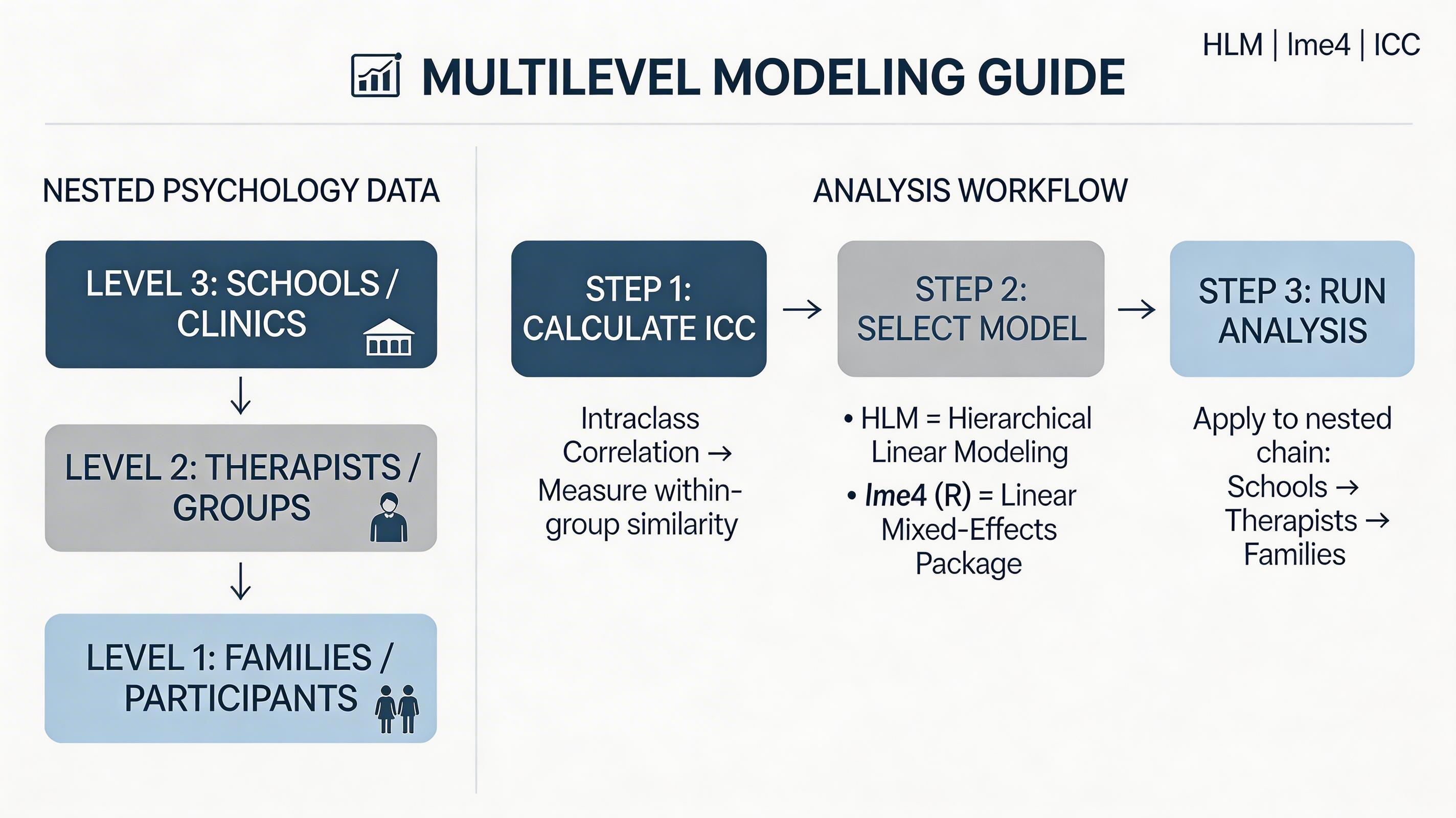
Multilevel Modeling Guide
Run hierarchical linear models for nested psychology data — schools, therapists, families
¥29.99
276 researchers installed this
About this skill
What it does
Guides psychology researchers through multilevel modeling (HLM/MLM) for data with nested structures.
Common applications
- Students nested within classrooms or schools
- Clients nested within therapists
- Measurements nested within individuals (longitudinal)
- Family members nested within families
- Participants from multiple sites
Workflow steps
- ICC calculation — is MLM even necessary?
- Model building strategy — unconditional, random intercepts, random slopes
- Centering decisions — group-mean vs. grand-mean centering
- Level-1 and Level-2 predictors — what goes where and why
- Cross-level interactions — specifying and interpreting
- Software code: R (lme4/nlme), HLM 8, Mplus, SPSS Mixed
- Results reporting: fixed effects table, variance components, ICC
Interpretation prompts
Paste your model output and get a plain-language interpretation ready for your Results section.
Ideal for
Clinical, developmental, educational, and health psychology with any nested data structure.
What researchers say
Multilevel modeling was the biggest challenge in my postdoc research on school effects. This skill helped me specify the correct random effects structure for my three-level model (students within classes within schools) and write up ICC values and model comparisons properly.
¥29.99
276 researchers installed this
Secure checkout via Alipay
About the Creator
Dr. Wei Chen
@dr_chen
Quantitative researcher specializing in behavioral psychology. 10+ years building research workflows.
Details
- Category
- Statistical Methods
- Installs
- 276
- Published
- Mar 13, 2026